Walk Buenos Aires, one hundred metres at a time
The whole world starts under fog. Buenos Aires is flat, gridded and enormous, which makes it one of the easiest cities to walk and one of the slowest to finish.
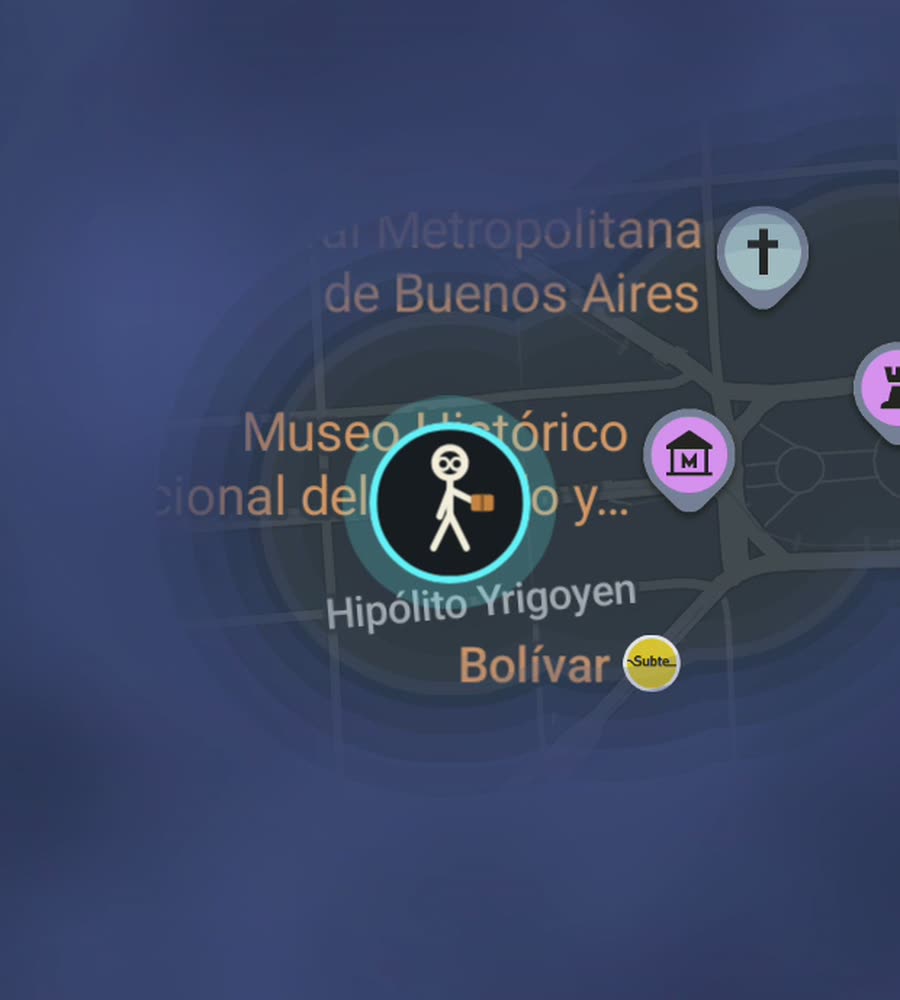
Buenos Aires in FOG, with the grid cleared block by block along a walked route from Plaza de Mayo out through Recoleta.
A grid of one hundred metre blocks
Buenos Aires is flat. Not mostly flat, flat, with the only honest slope being the drop from the old town down toward the water at Puerto Madero. The plan is a Spanish colonial grid of cuadras, blocks of roughly one hundred metres a side, running unbroken for kilometres in every direction.
That geometry does two useful things. You cannot get lost, because every corner tells you where you are. And you can zigzag: walking two sides of every block instead of straight down one avenue nearly doubles the number of separate streets you cover for the same distance on your legs. In a gridded city that is the whole trick.
Barrios worth crossing
San Telmo has the cobbles and Plaza Dorrego. Monserrat and the Microcentro hold Avenida de Mayo, which runs dead straight from Plaza de Mayo to Congreso, and Calle Florida, which is pedestrianised and permanently crowded. Recoleta is wide pavements, Avenida Alvear and the cemetery walls. Palermo is really several barrios in a coat, Soho, Hollywood and Chico, plus the Bosques de Palermo and the rose garden.
Further out, Villa Crespo, Almagro, Caballito and Belgrano are ordinary residential grid, which is exactly where casual walkers stop and where the map stays dark. Avenida 9 de Julio is the widest street you will cross anywhere and it takes two light cycles to do it.
The afternoon walk
Start at Plaza de Mayo. Take Avenida de Mayo west to Congreso, about a kilometre and a half of it, then turn north up Callao. Cut across into Recoleta, walk the streets around the cemetery and Plaza Francia, then drop into the Palermo parks near Plaza Italia. Roughly eight kilometres, four barrios, no repeated street.
If you want density instead of distance, do San Telmo in a spiral. Small blocks, short streets, and the fog comes off in a solid patch rather than a thin line across the map.
Heat, shade and the plane trees
Summer, roughly December through March, is humid and heavy, and the middle of the day is not worth arguing with. The city compensates with shade: the plane trees over Recoleta and Palermo keep whole avenues walkable in January. Winter is mild, mostly dry and grey, and is quietly the best walking season here.
Pavements are uneven in places and the crossings are busy. The standard local advice applies. Watch the corners, and assume the buses are not going to yield.
Why the percentage moves slowly
The city proper is forty eight barrios across about two hundred square kilometres, and Greater Buenos Aires is several times larger again. Your city percent will climb slowly here, and that is the correct reading rather than a fault. Nobody finishes this one on a weekend.
FOG reveals every street you physically walk and keeps it revealed. It works with the app closed and the screen off, so a long day of walking records itself without you touching the phone. There is no account and no cloud copy, and you can export your own data. Free to explore, and one purchase of USD 5.99 unlocks unlimited ranks, every character and history import.
Questions people actually ask
How much of Buenos Aires can I realistically light up?
Less than you expect. The city is around two hundred square kilometres, so city percent moves in small steps. The grid does mean every walk adds new streets rather than repeating them.
Does FOG need mobile data while I walk?
Your map is built from where you physically go, and it is stored on the phone. There is no account, no sign-up and no cloud.
Can I bring in old walks?
Yes. The paid unlock includes history import from Google Timeline exports and GPX files.
What does the purchase cost?
USD 5.99, once. It unlocks unlimited ranks, every character and history import. There is no subscription.
Start with a dark map.
FOG is free to explore. No account, no subscription, and your map never leaves your phone.
free to explore · one purchase unlocks everything · never a subscription