Madrid is small in the middle and stubborn at the edges
The whole world map in FOG starts hidden. Madrid's centre is compact enough that it lights up quickly, and hot enough in August that when you walk matters as much as where.
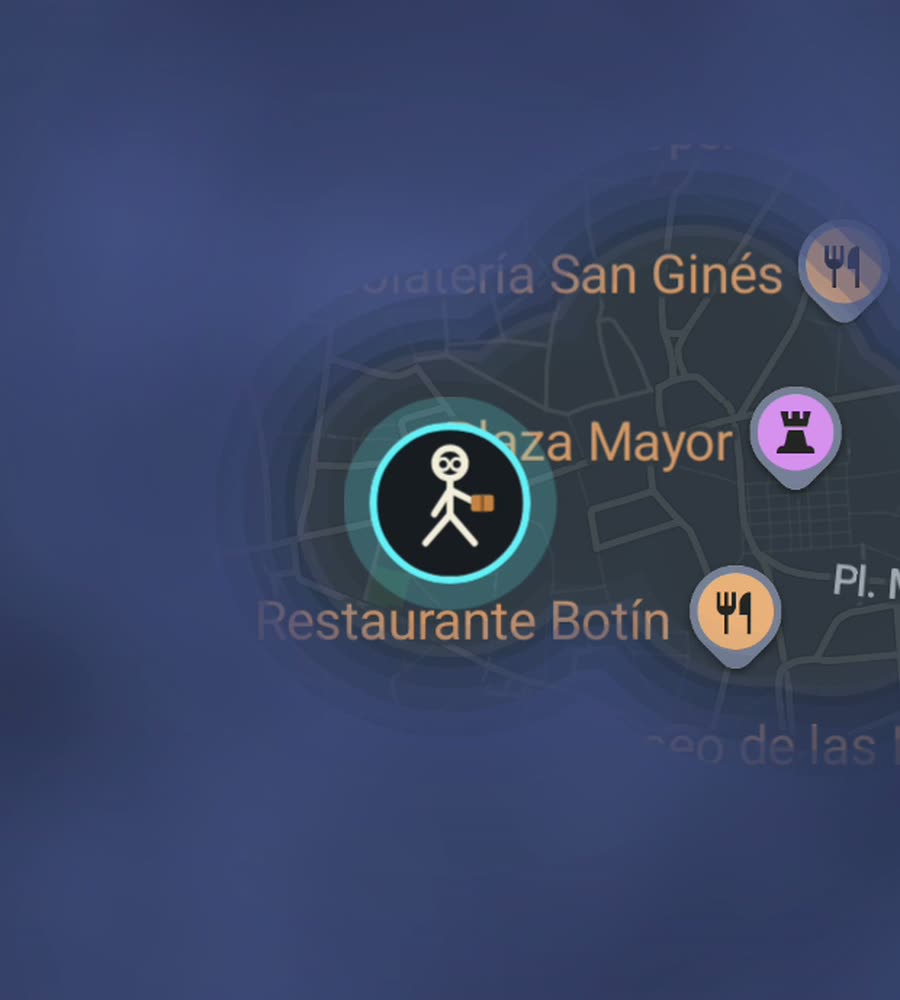
Madrid on the FOG map, the fog cleared through the old streets around La Latina and out along the Paseo del Prado.
The terrain and the calendar
Madrid sits at about 650 metres on the Castilian plateau, and the altitude sets the weather. Summers are severe. July and August routinely pass 38 degrees and the afternoon is simply not walking time. Winters are cold, dry and clear, and are honestly the better season for covering ground. The local line about nine months of winter and three of hell is not much of an exaggeration.
Everyone adapts the same way: walk early, sit out the middle of the day, and go out again at eight in the evening when the streets refill. Madrid keeps later hours than almost anywhere in Europe, so a summer evening walk from nine to midnight is completely normal and the map does not care what time it is.
The ground itself is gentler than Lisbon or Porto. There are slopes, mostly the drop west from the old town down to the Manzanares, but nothing that punishes you. Long flat stretches like the Paseo del Prado make covering distance easy.
Two street patterns, two fill rates
The Madrid de los Austrias, the Habsburg core around Plaza Mayor, Calle Mayor and La Latina, is a knot of narrow streets that never got redesigned. It fills fast because the blocks are tiny. Cava Baja, Calle del Nuncio, the lanes around San Andres: a short walk covers a lot of named streets. Lavapies and Malasana behave the same way, tight and irregular and full of one block streets.
Then there is the Barrio de Salamanca, laid out in the nineteenth century as a proper rectangular grid east of the Retiro. Serrano, Velazquez, Goya, Ortega y Gasset. It is a completely different job. You sweep it in rows, up one street and down the next, and it fills in evenly and predictably. Chamberi to the north works much the same way.
An afternoon that takes real ground
Start at Puerta del Sol. Go west through Plaza Mayor and down into La Latina, then out through the Puerta de Toledo and drop to Madrid Rio, the linear park along the Manzanares where the ring road used to be. Follow the river north as far as you like, cross to the Casa de Campo side, and climb back up through the Palacio Real and the Sabatini gardens to Opera.
The other classic is the museum axis. Gran Via east to Cibeles, right down the Paseo del Prado past the Prado and the botanical garden, then up into the Retiro and out the far side into Salamanca. The Retiro is 125 hectares and lights up as a large solid block rather than a thin thread, which makes it good value.
Why the fog feels good in Madrid
Central Madrid is genuinely small. From Sol you can reach Lavapies, Malasana, Chueca and the Retiro on foot in twenty minutes each, so the first weeks of walking move the percentage noticeably. The old core is the fastest filling part of the city.
It gets harder at the edges. Casa de Campo alone is more than 1,700 hectares of parkland west of the centre, and the outer districts, Carabanchel, Vallecas, Tetuan, Chamartin, are ordinary residential city that goes on much further than visitors imagine.
FOG hides the whole world until you walk it, keeps revealing with the app closed and the screen off, and shows what percentage of Madrid you have lit. No account, no cloud, no ads, no tracking, and the map never leaves your phone. Free to explore, with one purchase of USD 5.99 for unlimited ranks, every character and history import. Never a subscription.
Questions people actually ask
When is the best time to walk Madrid?
Winter mornings and summer evenings. Afternoons in July and August regularly pass 38 degrees, and nobody is walking in that.
Does the metro count?
No. FOG reveals ground you physically cover. Underground journeys leave the streets above them dark.
Can I import walks I already did here?
Yes. History import reads Google Timeline exports and GPX files. It is included in the one time unlock.
Is my location data uploaded anywhere?
No. No account, no sign up, no cloud. The map stays on the phone and you can export it.
Start with a dark map.
FOG is free to explore. No account, no subscription, and your map never leaves your phone.
free to explore · one purchase unlocks everything · never a subscription